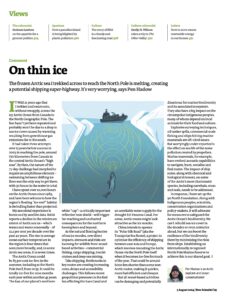
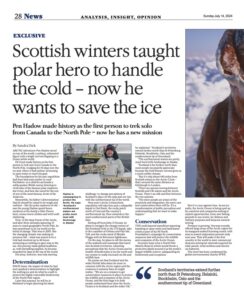
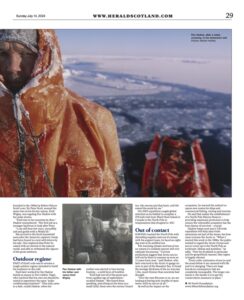
Read full article at TheGuardian.com
2025 Arctic Report Launched
Remarkable response from national delegations within UN body to proposal from 90 North Foundation
With global ocean biodiversity forecast to be in deep crisis within decades, British polar explorer, Pen Hadow, presented a landmark report this week at the UN International Maritime Organization (IMO) headquarters, the governing body for global shipping. The report provides a comprehensive assessment of the risks facing the biodiversity in the world’s only polar ocean, the Arctic Ocean, with a special focus on the risks posed by future vessel-based activities in the waters surrounding the North Pole as its perennial sea -ice cover recedes due to climate change. The report also offers a possible solution. It makes clear the IMO signatory nations have the option to designate this high seas region as a Particularly Sensitive Sea Area (PSSA) involving specific restrictions on vessel activity.
Remarkably, six IMO signatory delegations have since approached 90 North Foundation indicating their initial interest in the proposed solution, with further interest anticipated from more nations in the weeks ahead. The next step requires one or more of these nations to investigate the opportunity, with technical and scientific advice provided by 90 North Foundation and other expert bodies, before one or more nations decide to make a formal application for this PSSA through the IMO’s Marine Environment Protection Committee (MEPC). Once the PSSA is on the MEPC agenda, wider engagement and discussions with IMO delegations will reveal any modifications necessary to the PSSA’s Associated Protective Measures, before a finalised proposal is put to a decisive consensus vote held by MEPC at the IMO HQ in London.
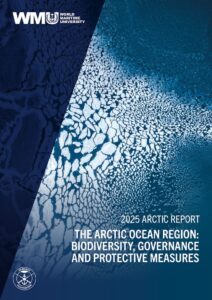
2025 Arctic Report
The report is a product of a collaboration between the marine conservation organisation, 90 North Foundation, and the UN-affiliated research institution, the World Maritime University (WMU). The report warns that the Arctic Ocean, long perceived as remote and inaccessible, is now experiencing a profound environmental, economic, and political transformation. As global greenhouse gas emissions continue to increase, the pause in the retreat of summer sea-ice cover over the last decade, is expected to recommence. Consequently, new international shipping routes and resource extraction opportunities will arise which, if unchecked, will result in unprecedented ecological and cultural threats in the high Arctic.
According to the report, the Central Arctic Ocean’s high seas region around the North Pole, which is roughly equivalent in area to that of India or Argentina, has had its economic potential widely overstated, particularly for international cargo shipping, commercial fishing and hydrocarbon extraction. Analyses that present the Arctic as a shortcut for global trade or a new frontier for resources often ignore the region’s harsh environmental conditions, complex geophysical constraints, serious ecological vulnerabilities, likely low-level fish stocks, and paucity of hydrocarbon reserves (though some critical minerals may exist in localised pockets).
Pen Hadow, founder and executive director of 90 North Foundation, stated, “As the natural barrier provided by the sea-ice cover recedes, man-made protective measures are now required to restrict deleterious vessel activity in the world’s least-disturbed marine ecosystem. There is now an urgent need to consider Particularly Sensitive Sea Area status for the Central Arctic Ocean’s high seas region to help protect the increasingly vulnerable biodiversity, already stressed by the loss of its sea ice habitat.”
The report highlights that Arctic ecosystems possess unique characteristics: slow recovery rates, highly specialized biodiversity, and extreme seasonal variations. These traits make them exceptionally sensitive to disturbance from industrial activity and climate change.
Indigenous communities—who have sustainably lived in and cared for the Arctic for thousands of years—are among those most at risk. The report outlines the existential pressures these communities face, including threats to food security, cultural continuity, and territorial sovereignty. Industrial-scale operations often proceed without meaningful Indigenous consultation, further exacerbating social and environmental inequities.
Professor Maximo Q. Mejia, Jr, President of the World Maritime University, emphasized the importance of interdisciplinary collaboration and global engagement saying, “The Arctic is at the forefront of profound transformations driven by climate change, industrial activity, and shifting geopolitical dynamics. The challenges of Arctic governance demand the integration of science, policy, cultural perspectives, and Indigenous knowledge. This report reflects the shared commitment of WMU and the 90 North Foundation to developing forward-looking frameworks that protect fragile Arctic ecosystems while fostering sustainable development.”
To confront these urgent challenges, the report advocates for the development of a cohesive, adaptive, and science-driven governance framework for the Arctic Ocean. Central to this vision is the expanded use of tools such as:
- Particularly Sensitive Sea Areas (PSSAs) under the International Maritime Organization
- Ecologically or Biologically Significant Areas (EBSAs)
- Marine Protected Areas (MPAs) under the new Biodiversity Beyond National Jurisdiction (BBNJ) Agreement
- Enhanced cooperation following the model of the Central Arctic Ocean Fisheries Agreement
By integrating existing designations with new protective measures, the report outlines a specific pathway for safeguarding the high seas region of the Central Arctic Ocean as a haven for biodiversity, scientific endeavour and peaceful international cooperation. The research was funded by the 90 North Foundation and the report was authored by Antonios (WMU), Dr Graeme Chesters (90 North Foundation), and Prof Dimitrios Dalaklis (WMU).
To access the report, visit: https://commons.wmu.se/lib_reports/92/
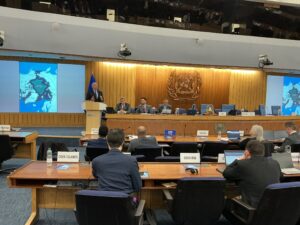
Pen Hadow, 90 North Foundation, speaking at IMO General Assembly, London, for launch of the 2025 Arctic Report with WMU
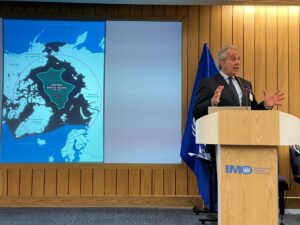
Pen Hadow, 90 North Foundation, speaking at IMO General Assembly, London, for launch of the 2025 Arctic Report with WMU